In the world of mass (High-Volume) production, planning is simple—the line runs at a steady rhythm. But what happens when new orders come in every day, production runs are short, and changeovers are frequent? For production directors and planners operating in a High-Mix / Low-Volume model, Excel is no longer enough. In this article, we explain why static ERP systems fail in dynamic environments and how MeMOM—a next-generation digital platform—solves the problem of "bottlenecks" using adaptive algorithms.
Most manufacturing companies start scheduling their manufacturing operations with a spreadsheet. However, in lot-size-one or custom production, there are simply too many variables for the human brain or a statictable to handle.
The main problems with the traditional approach are:
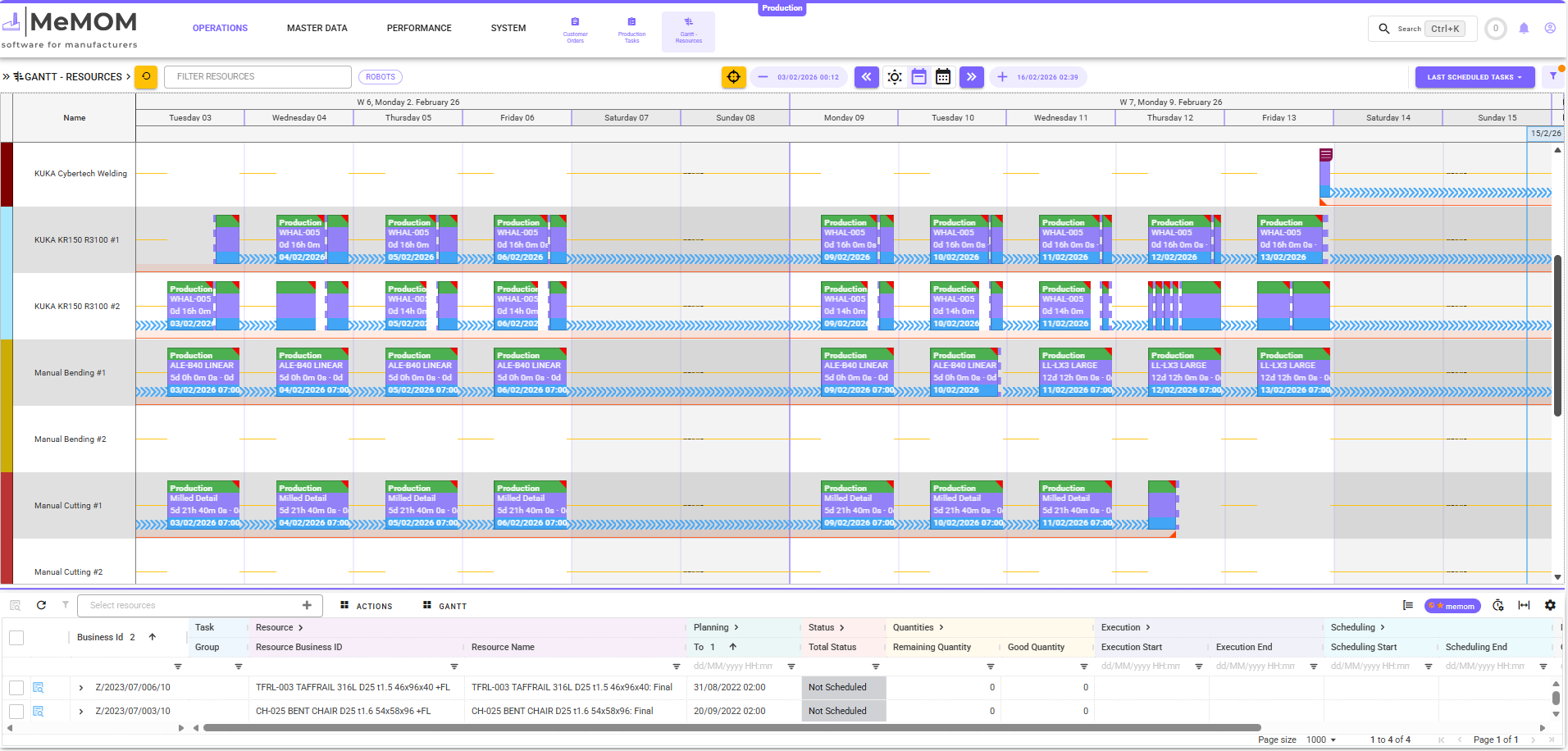
You need a tool that doesn't just display the plan, but actively recalculates it in response to changes.
A traditional MES (Manufacturing Execution System) is used to collect data. MeMOM goes a step further by combining MES functions with advanced APS (Advanced Planning and Scheduling).
Let’s imagine a scenario: An urgent order needed "yesterday" comes in, andone of the key machines breaks down.
In the MeMOM system, the process looks like this:
This is what we call the Adaptive Loop. The system "learns" the efficiency of your shop floor and combines is with a plan for future. By collecting more and more data, it plans more precisely with every order.
For engineers and management, hard data counts. Implementing digital operations management in the MeMOM model translates to:
High variability production doesn't have to mean chaos. It only requires tools adapted to its dynamics. If your company is wasting time constantly updating Excel—it’s time to check how the algorithms in MeMOM work.
Contact us to schedule a free demonstration of the system using your data!
Yes. Unlike "heavy" corporate systems, MeMOM is designed to be accessible to the SME sector (subscription model instead of license purchase and expensive infrastructure, better access to consultants, including an AI agent to assist the user).
MeMOM acts as an operational layer. It pulls orders from the ERP, optimizes their execution on the shop floor, and sends back feedback regarding their completion status.
Thanks to its cloud architecture and predefined templates for discrete manufacturing, initial results can be seen in just a few weeks, rather than years.
Stay updated with our latest blog posts.